Tizi n'Tichka pass: what the road from Marrakech to Ouarzazate is really like
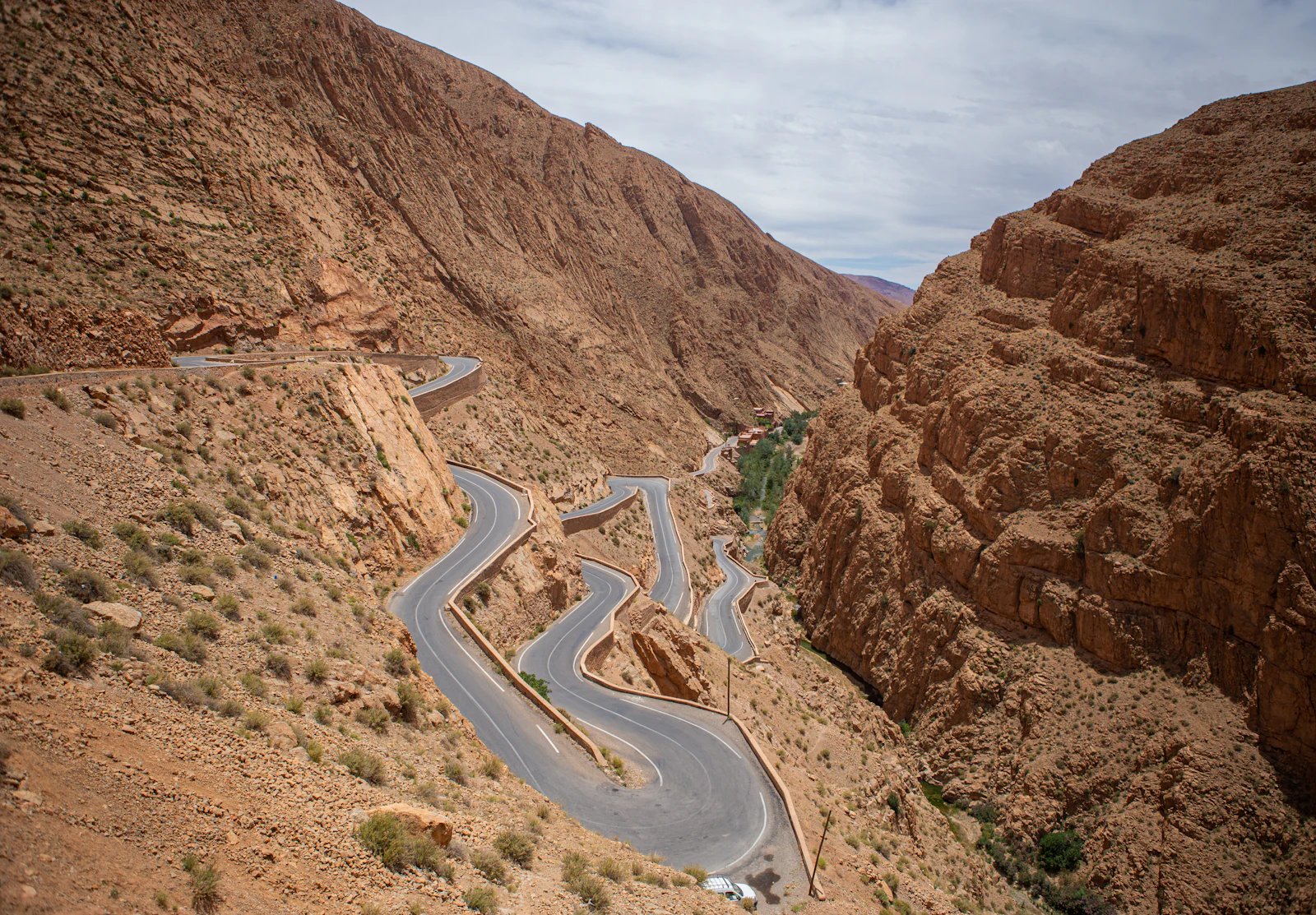
The Tizi n'Tichka pass is the high point of the N9, the main road from Marrakech to Ouarzazate, at 2,260 m above sea level. The full crossing is 195 km and takes about 4 hours by car, with the summit roughly 105 km from Marrakech. The road is paved all the way and has been widened in recent years, but it remains a mountain road with long series of bends, slow trucks and occasional winter closures.
Where is the Tizi n'Tichka pass and why does it matter?
The pass crosses the High Atlas south-east of Marrakech. It is the highest pass on a main road in Morocco and the only direct route between Marrakech and the south: Ouarzazate, Aït Ben Haddou, the Dadès valley and the desert beyond. There is no train and no motorway alternative. The detour through Agadir adds several hours.
The road was built in the 1930s to replace the old caravan track through Telouet. "Tizi" means pass in Tamazight, and Tichka is usually translated as mountain pasture.
- Road: N9, paved, two lanes with overtaking sections
- Summit altitude: 2,260 m
- Marrakech to Ouarzazate: 195 km, about 4 hours
- Marrakech to the summit: about 105 km, 2 h 15
- Snow risk: mainly December to February
- Fuel: Aït Ourir, Taddert, Agouim, Ouarzazate
What is the road like, section by section?
Marrakech to Aït Ourir: the plain
The first 35 km are flat and fast across the Haouz plain. Aït Ourir is the last proper town before the mountains and a sensible place for fuel and water.
Aït Ourir to Taddert: the foothills
The road starts climbing through pine and oak, drops into the Zat valley, then climbs again. Bends are frequent but open. Taddert, at around 1,650 m, is the traditional truck stop: grills, tagines and mint tea line the roadside.
Taddert to the summit: the hairpins
This is the stretch people photograph. In about 15 km the road gains 600 m in a staircase of hairpin bends above bare red and green slopes. The widening works added lanes and guard rails on most of it. Trucks still crawl uphill, and overtaking is only safe on the marked sections.
Summit to Ouarzazate: the long descent
The south side is drier and gentler. The road follows a broad valley through Igherm N'Ougdal and Agouim, straightens after Amerzgane and reaches Ouarzazate at 1,150 m. The turn-off for Aït Ben Haddou is about 20 km before the town.
Is the Tizi n'Tichka pass dangerous?
It has a worse reputation than it deserves today. The surface is good, the lanes are wide for most of the route and barriers protect the exposed corners. Some sections may still have roadworks or temporary surfaces at the time of writing, so expect short slow zones.
The real risks are impatience and darkness. Most incidents involve overtaking on bends. After sunset, unlit vehicles, fog near the top and rockfall debris make the drive much harder. Cross in daylight if you can.
Motion sickness is common. Sit in the front, eat lightly before leaving, look at the horizon and ask for a pause at Taddert or at the summit. A steady driver matters more than a fast one.
Snow, fog and summer storms: when does the pass close?
Snow falls on the summit most winters, mainly from December to February. The authorities close the barriers when ploughs are working. Closures typically last a few hours, sometimes a day or more after a heavy fall. Morning ice is possible from November to March.
Late summer brings a different problem: violent afternoon storms can wash mud and stones onto the road in August and September. In both seasons, check conditions on the morning of travel and keep a flexible plan if you have a flight to catch.
Where to stop on the Tichka road
- Taddert: coffee, grilled meat and a break before the bends.
- The summit: a sign, a few stalls selling minerals and fossils, wide views. Bring a jacket: it is often 10 to 15°C colder than Marrakech.
- Telouet: a few kilometres past the summit, a side road leads about 20 km to the Glaoui kasbah, half ruined outside, richly decorated inside. Allow 1 h 30 for the detour.
- The Ounila valley: from Telouet a narrow paved road follows the old caravan route down to Aït Ben Haddou. It adds about an hour to the day and is the most scenic way to finish.
Bus, rental car or private driver over the pass
Bus. CTM and Supratours coaches run between Marrakech and Ouarzazate several times a day. The trip typically takes 4 h 30 to 5 hours and costs around 100 MAD at the time of writing. Coaches are comfortable and the drivers know the road. They make one short break and no detours.
Shared grand taxi. Cheap and frequent in the morning, leaving when all six seats are sold. Tight for tall travellers, and the driving can be brisk.
Rental car. Perfectly feasible for a confident driver in daylight. You set your own stops. You also do all the concentrating, and the driver sees the least of the scenery.
Private driver. A private transfer from Marrakech to Ouarzazate costs €110 per sedan, €130 per minivan and €180 per minibus, one way, fuel included. It suits families, groups of three or more and anyone who gets car sick, because the driver adapts the pace and stops when you ask. Short stops are free. A solo traveller on a budget will be well served by the bus.
Going only as far as the ksar? There is a separate fixed price for the transfer from Marrakech to Aït Ben Haddou. If the pass is the first leg of a desert trip, read our Marrakech to Merzouga drive guide for the stages beyond Ouarzazate. And if mountain roads are not for you, the road from Marrakech to Essaouira is flat from start to finish. You can book a driver online at any hour.
Key takeaways
- The Tizi n'Tichka pass reaches 2,260 m on the N9 between Marrakech and Ouarzazate.
- Marrakech to Ouarzazate is 195 km and takes about 4 hours by car, 4 h 30 to 5 hours by coach.
- The road is paved and widened. The steepest hairpins are the 15 km between Taddert and the summit.
- Snow can close the pass for a few hours between December and February. Cross in daylight.
- A private transfer over the pass costs €110 per sedan, €130 per minivan and €180 per minibus.
Comments (0)